

The premiere source of truth powering network automation. Open and extensible, trusted by thousands.

NetBox is now available as a managed cloud solution! Stop worrying about your tooling and get back to building networks.
RJ45 isn't really RJ45
By stretch | Saturday, November 8, 2008 at 6:22 a.m. UTC
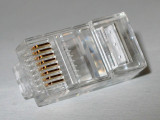
Some interesting trivia for your Saturday: the ubiquitous network cabling plug best known as RJ45 has been living a lie. Technically speaking, the RJ45 designation actually refers to a registered jack, a telecommunications standard which defines both the mechanical interface (plug) and the wiring scheme used to terminate a cable. The modular connector itself is officially designated 8P8C (8 positions, 8 contacts), while the wiring standards used to terminate twisted-pair cabling are defined in TIA/EIA-568-A and B.
So why the mix-up? One can assume that the telco RJ nomenclature was subconsciously carried over to the network world by cable plant installers when twisted-pair LANs started gaining popularity in the late eighties and early nineties, and the terminology has simply stuck ever since.
Posted in Random
Comments
June 20, 2011 at 6:32 a.m. UTC
So why does RJ45 have this weird switch of green and blue? IE why is the standard not white/orange, orange, white/green, green, white blue, blue, white brown, brown.
It would make wiring a lot easier.
November 20, 2011 at 9:38 p.m. UTC
David: The color and white/color wires are twisted together as a pair within the cable, so from the cable manufacturing end of things, the scheme makes sense.
On the connector, things are a little more interesting. If you notice, the T568B standard (which is the standard I'm assuming you're using; there's two to choose from!) is
1 White/Orange
2 Orange
3 White/Green
4 Blue
5 White/Blue
6 Green
7 White/Brown
8 Brown
If we drop off the outer two pairs, we have:
3 White/Green
4 Blue
5 White/Blue
6 Green
This is compatible with two-line/four-conductor telephone connectors. Sure enough, you can plug a "RJ-11" or "RJ-14" connector into a "RJ-45" jack and it'll physically work. (I wouldn't make a habit of this.) This part of the scheme makes sense.
The part that doesn't immediately make sense is why it's not White/Brown, Orange, White/Green, Blue, White/Blue, Green, White/Orange, Brown -- in other words, why doesn't the pattern hold outside of the inner two pairs. Turns out that the spacing would be too great, and the twisted pair magic would be significantly impacted at high frequencies.
tl;dr: backwards compatibility, constrained by physics.