

The premiere source of truth powering network automation. Open and extensible, trusted by thousands.

NetBox is now available as a managed cloud solution! Stop worrying about your tooling and get back to building networks.
Evaluating a Catalyst 6500 at 320 Gbps
By stretch | Friday, May 16, 2008 at 12:32 a.m. UTC
I've often wondered how networking equipment manufactures set about testing the throughput of their gear under various conditions. Today on cisco-nsp someone referenced this analysis (PDF link) of a Catalyst 6509 with a Sup720 and eight WS-X6704-10GE modules. That's a total of 32 10Gig Ethernet interfaces.
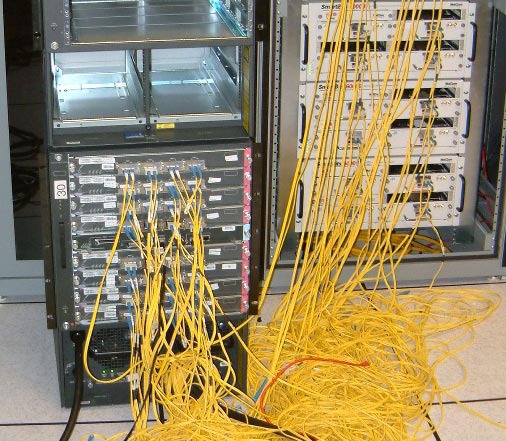
Tests performed include:
- Single card maximum forwarding rate
- L3 switching latency
- L2 maximum forwarding rate
- IPv4 and IPv6 maximum forwarding rate (with and without applied services)
The evaluation was conducted by the European Advanced Networking Test Center, and the strategies they used provide great insight to the inner-workings of the 6500 platform. Overall the 6500 performed exceptionally, but what really interests me is the gear and logic used to stress performance. The equipment used in this instance was a cluster of Spirent SmartBits traffic analyzers. Not exactly cheap, but still very cool.
Posted in Hardware
Comments
May 20, 2008 at 2:59 p.m. UTC
You know, if they install VSS1440 and a second chassis they could double it.
March 14, 2010 at 12:01 p.m. UTC
Actually the "1440" does not mean 1440Gb/s, but rather two SUP720's.